Exterior Solar Screens
Exterior Solar Screen Installation
for California Homes
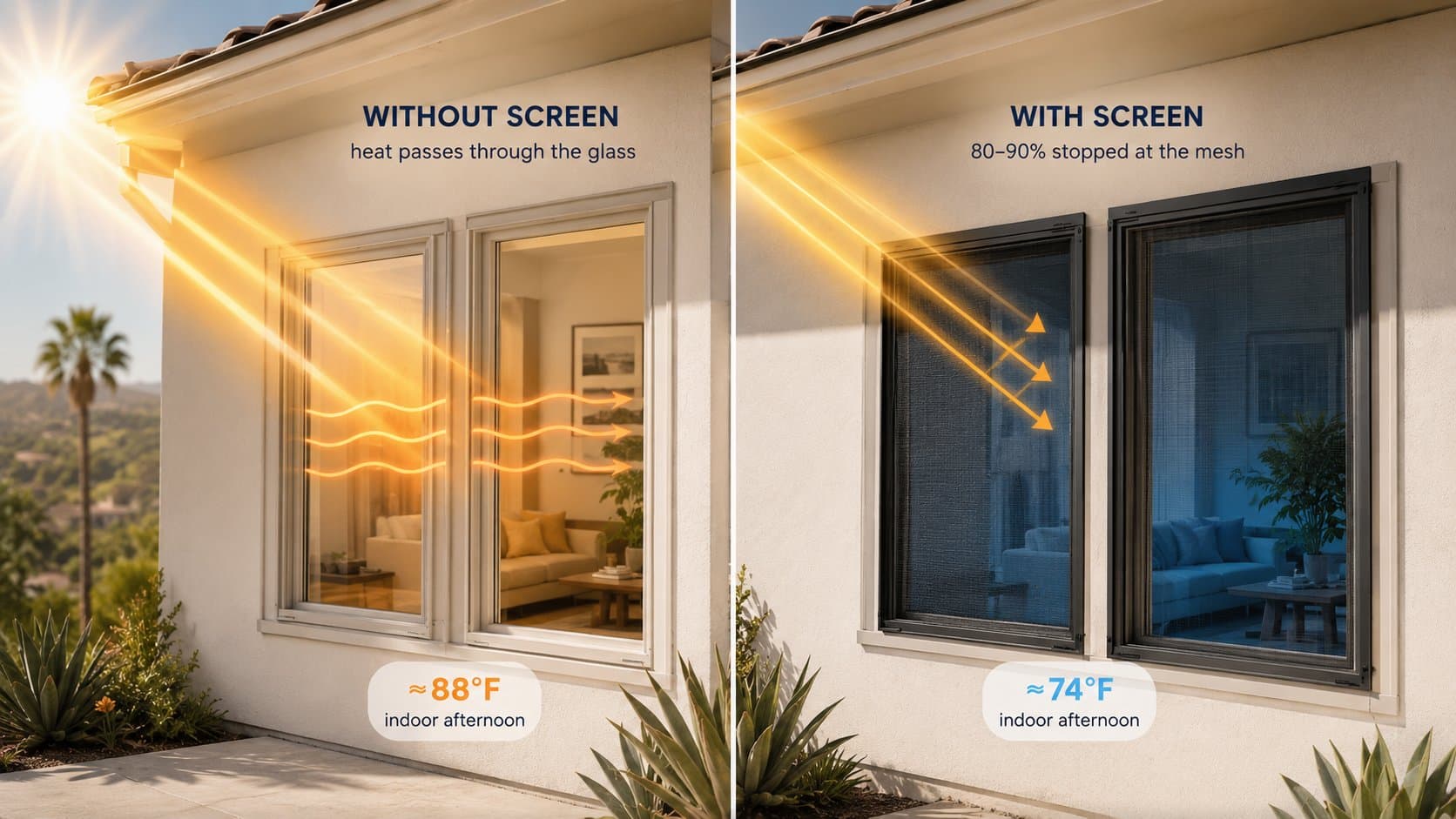
The most efficient way to stop summer heat is to block it before it gets through your window. Exterior solar screens stop 80–90% of solar heat at the glass — before your AC ever has to deal with it.
Custom-measured for your windows · Professional installation · Same-day on most homes
8–15°F Cooler Rooms
South- and west-facing rooms drop dramatically on hot afternoons — without changing your AC settings.
80–90% Heat Blocked
Solar screens stop the majority of solar heat before it converts to indoor temperature.
Lower AC Load
Your AC starts the afternoon with less heat to fight — it runs shorter cycles and uses less energy.
Furniture & Floor Protection
Solar screens block UV rays that fade hardwood, artwork, rugs, and upholstery.
See Out. Not In.
You keep clear outward visibility during the day. Passersby can't see in.
How exterior solar screens actually work
Heat enters your home in two ways: through your walls and ceiling (which insulation addresses) and through your windows (which insulation does nothing about). Windows are a direct pathway for radiant solar energy — and on a sun-facing window on a 95°F afternoon, a standard window lets in an enormous amount of heat.
The only efficient place to stop that heat is before it hits the glass.
Exterior solar screens are installed on the outside surface of your window frame. They're made from a tightly woven mesh fabric — typically 80% or 90% shade factor — that intercepts incoming sunlight and reflects or absorbs the solar energy before it can pass through the glass and heat the interior air.
The difference versus interior blinds or window film is significant. Interior blinds stop light, but solar energy has already passed through the glass and is already inside your home — you're just trapping it between the blind and the window. Exterior screens stop the energy at the source, before it converts to heat indoors. Exterior screens are significantly more effective than interior solutions at reducing heat gain — because they stop solar energy before it enters, rather than after.
Exterior solar screens vs. window film vs. interior blinds
| Feature | Exterior Solar Screens | Window Film | Interior Blinds / Shades |
|---|---|---|---|
| Heat blocked before glass | Yes | Partially | No |
| UV protection | Yes | Yes | Partial |
| Outward visibility | Clear | Clear | Reduced |
| Daytime privacy | Yes | No | Yes |
| Removable / seasonal | Yes | No | Yes |
| Effectiveness on hot days | Highest | Moderate | Low |
| Installation | Professional | Professional | DIY |
For homeowners dealing with genuinely hot rooms on sunny exposures, exterior screens deliver the largest temperature reduction. Window film is a reasonable second choice. Interior blinds help with glare but do very little for heat.
Which windows and homes benefit most
You'll see the biggest impact on:
- West-facing windows that take direct afternoon sun (2–7 PM exposure)
- South-facing windows that receive sun most of the day
- Second-story bedroom windows that overheat in the afternoon
- Sliding glass doors or large picture windows
- Windows in rooms with electronics, artwork, or hardwood flooring you want to protect
- Any room that's noticeably hotter than the rest of the house in summer
You may see moderate impact on:
- East-facing windows (morning sun only — less intense)
- North-facing windows (minimal direct sun in California — screens may not be worth it here)
We identify which windows to prioritize during your free assessment. Many homeowners don't need screens on every window — just the ones that are costing them the most.
The screens we install
We install exterior solar screens using commercial-grade mesh fabric in 80% and 90% shade factor ratings, custom-fabricated to fit your exact window dimensions.
80% shade fabric
Blocks 80% of solar radiation. Maintains slightly more visibility and light than 90% screens. Recommended for rooms where natural light is a priority alongside heat reduction.
90% shade fabric
Blocks 90% of solar radiation. Provides greater heat reduction and enhanced daytime privacy. Recommended for the hottest exposures — west-facing bedrooms, south-facing living rooms.
Frame options
Standard black aluminum frames (most popular — clean, low-profile, low-maintenance), bronze, and white to match your window trim.
All screens are:
- Custom-measured per window (no standard sizes — every screen is built for your exact opening)
- Installed on the exterior of the window frame
- Removable for winter if desired (standard screen clips)
- Warranted against manufacturer defects
What installation looks like
Free In-Home Assessment
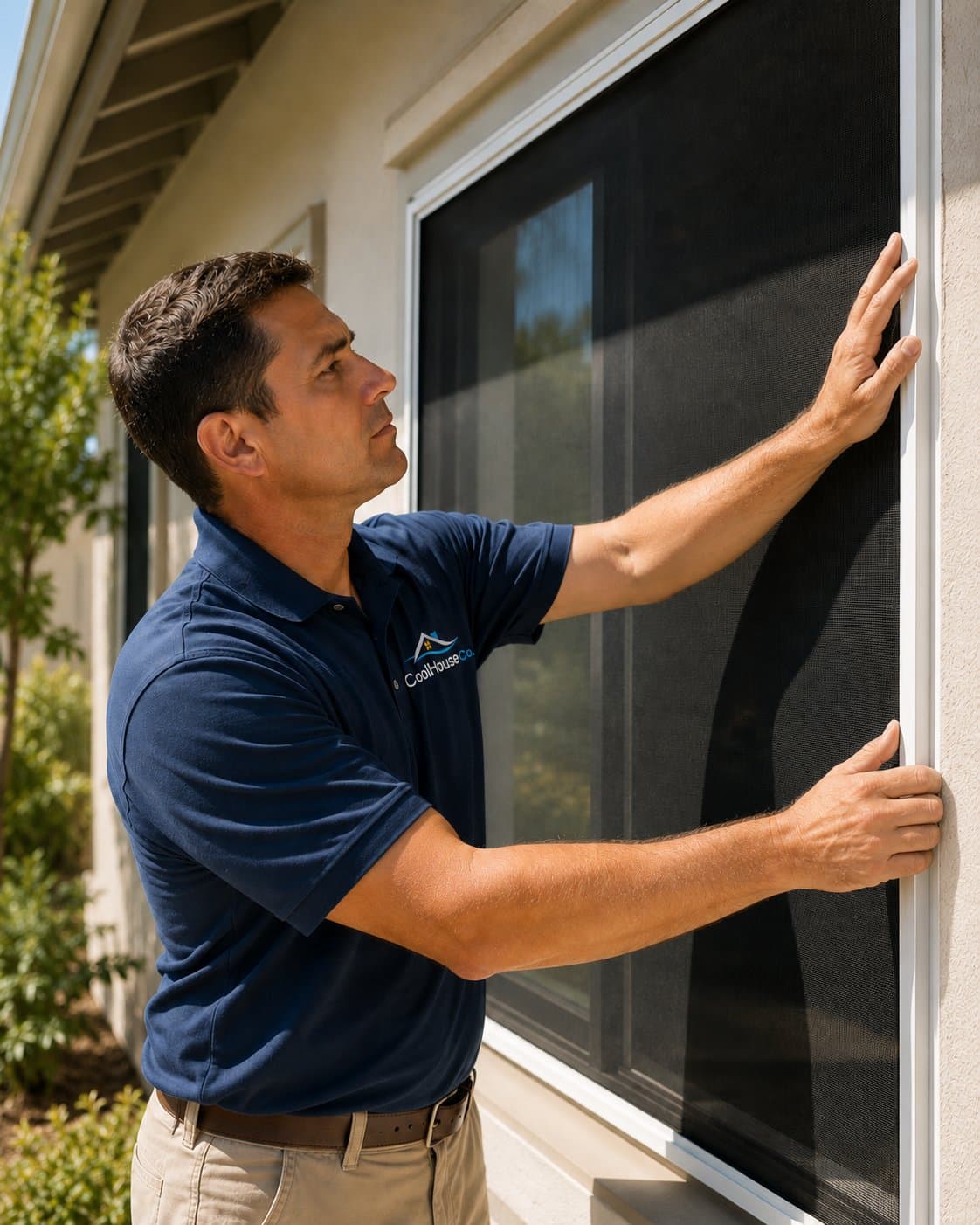
We measure every window you're interested in, assess sun exposure patterns by elevation and time of day, and recommend which windows will give you the best return on investment. You get a written quote before we leave.
Custom Fabrication
Your screens are custom-built to your exact window measurements — not cut from stock. Fabrication typically takes 3–7 business days depending on the number of windows.
Installation Day
Our crew installs all screens in a single visit. A typical whole-house screen installation (8–15 windows) takes 2–4 hours. We install, test for fit, clean up, and walk you through maintenance and removal.
Immediate Results
The difference is noticeable the same afternoon. Sun-facing rooms are measurably cooler by the time the afternoon sun hits. Most homeowners notice the difference within the first hot day.
Note on permits: Solar screen installation in California does not typically require a permit. We'll confirm this for your specific jurisdiction during your assessment.
Frequently asked questions about solar screens
Do solar screens make the inside of the house dark?
The honest answer is: yes, they reduce incoming light — that's part of how they reduce heat. However, most homeowners are surprised by how much visibility they retain. On an 80% screen, you can see clearly out the window in normal daylight. The room gets slightly dimmer but not dark. On a 90% screen, the reduction is more noticeable. We bring fabric samples to your assessment so you can hold them up to your own window and decide.
Can I still open my windows with solar screens installed?
Yes. Solar screens are installed on the exterior frame and don't interfere with the window operation. You can still open and close your windows normally.
How do solar screens look from the outside?
Clean and intentional. From the street, your windows will have a dark mesh appearance — similar to a standard window screen, but darker and more uniform. Most homeowners find they look professional rather than industrial. They don't read as 'modified' from the curb the way reflective window film can.
Are solar screens the same as security screens?
No. Solar screens are designed to block heat and UV light — the mesh is optimized for solar performance, not impact resistance. If you want security screening, that's a different product. We install solar screens only.
Can solar screens be removed for winter?
Yes. They're installed with standard screen clips and can be removed and stored for winter months, then reinstalled in spring. Many California homeowners leave them year-round since winters in most markets here are mild. We'll discuss what makes sense for your climate and orientation during your assessment.
Do solar screens work on sliding glass doors?
Yes — sliding glass doors are actually one of the highest-impact applications because they represent a large glass area with direct sun exposure. We custom-fabricate screens for sliding door openings, including oversized panels.
How long do solar screens last?
Quality solar screen mesh and aluminum frames are rated for 10–15 years of exterior use in California climates. They won't fade or degrade quickly in normal conditions. The mesh may need to be re-stretched or replaced after many years if damaged, but the frames are typically reusable.
How much do solar screens cost?
Cost depends on the number of windows, their sizes, and the fabric specification. We give you a complete written quote per window and per screen during your free assessment. We don't quote blind without measuring — every window is different.
Combine solar screens with a whole house fan for maximum impact.
Solar screens solve half the cooling problem — stopping heat from getting in. A whole house fan solves the other half — removing heat that's already inside when evening temperatures drop. Together, they're the most complete and cost-effective cooling upgrade available for a California home.
Homeowners who do both typically see the largest comfort improvement and the largest bill reductions. Ask us about both during your assessment — we can quote them together or separately.
Ready when you are
Stop paying to cool rooms the sun keeps overheating.
Free in-home assessment. We measure your windows, identify the highest-impact exposures, and give you a written quote — no obligation, no pressure.