Combined Home Cooling System
The Complete Home
Cooling System.
Most California homes have two cooling problems. Solar screens solve the first. A whole house fan solves the second. Together they're the most effective, most efficient upgrade you can make to a warm-weather home.
Both products installed by our local team · Usually in a single day · Free in-home assessment
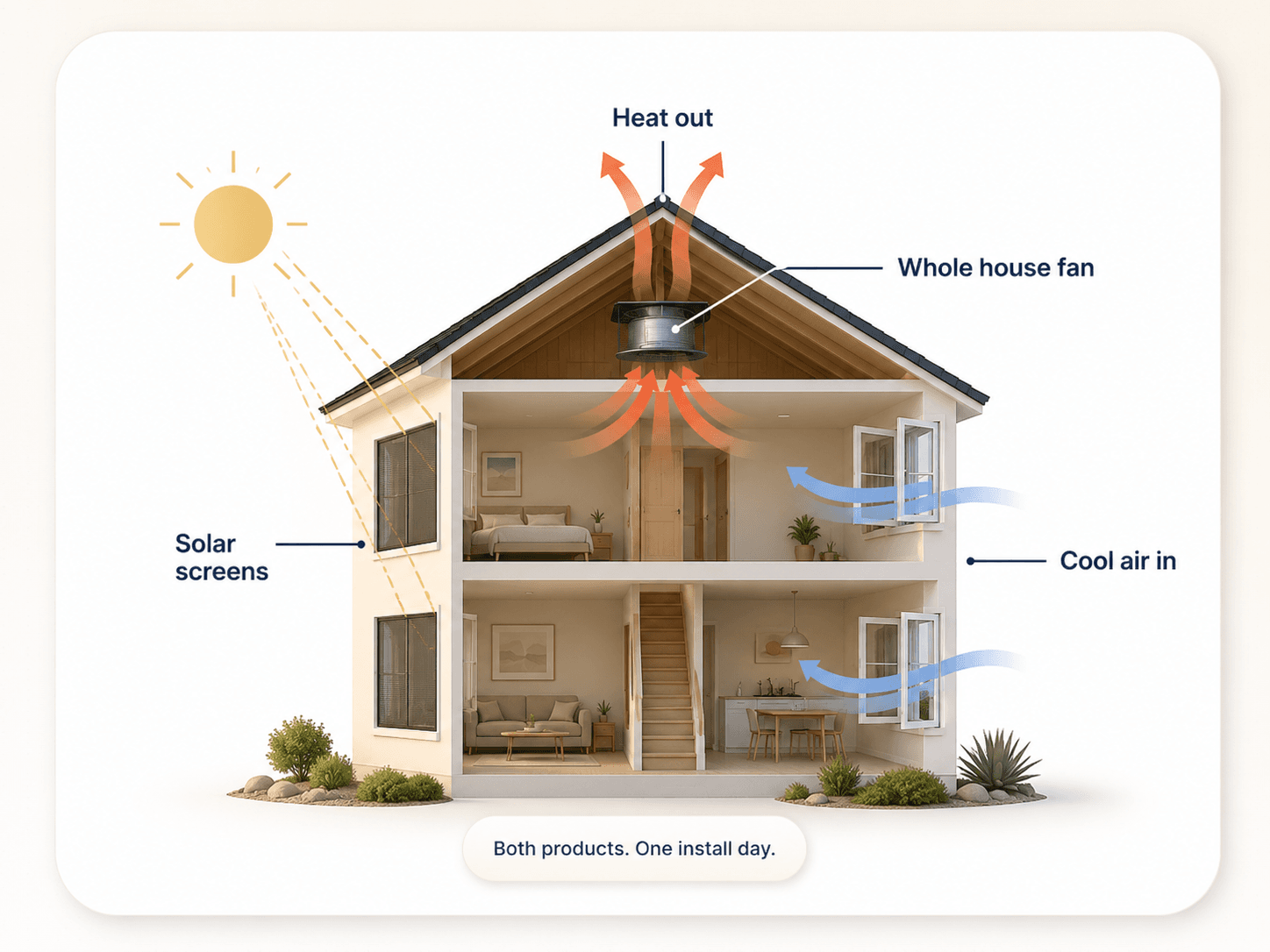
Why one solution is never enough
Most homeowners approach the hot-house problem the wrong way: they make the AC bigger, or they add insulation, or they buy a portable fan. None of these address the actual problem — because there are two separate problems happening simultaneously, and each one requires a different solution.
Problem 1: Heat getting into the home
During the day, solar radiation passes through your windows and converts directly to indoor heat. Your south- and west-facing windows are essentially solar collectors — and on a 95°F afternoon in California, they're working hard. Insulation doesn't stop this. Closing the blinds slows it slightly but doesn't stop the energy already through the glass. Your AC runs continuously just to offset heat that's continuously entering.
The solution: Exterior solar screens, installed on the outside of your windows, stop 80–90% of that solar energy before it hits the glass. The heat that never enters your home is heat your AC never has to remove.
Problem 2: Heat stored inside the home that won't leave
Even after the sun goes down, your home stays hot. This isn't just the air temperature — it's heat stored in your walls, ceilings, furniture, and attic that slowly radiates back into the living space for hours after sunset. Your attic can reach 140–160°F during a summer afternoon and keep pouring heat through the ceiling well into the night. Opening a window helps slightly, but it doesn't create enough airflow to actually flush the heat out.
The solution: A whole house fan creates powerful, directed airflow that pulls cool evening air through every room and pushes the accumulated hot air out through the attic — typically in 10–15 minutes. When outdoor temperatures drop into the 60s or low 70s (which they do, most evenings in most California markets), the fan gives that cool air a path through your entire home.
Why these two solutions are designed for each other
Solar screens reduce the heat load your home accumulates during the day. A whole house fan efficiently removes whatever heat does accumulate before it lingers overnight. They work on opposite ends of the same problem — and because of that, they amplify each other's results.
A home with solar screens heats up less during the day, which means the whole house fan has less heat to flush out in the evening — and cools down faster. A home with a whole house fan that runs every evening builds up less heat over time, which means the solar screens are working against a lower baseline. The combination produces results that are noticeably better than either product alone.
What homeowners experience with both installed
50%+ reduction in AC runtime during shoulder seasons
April through June and September through October are when the combined system does its best work. Outdoor evenings are cool enough to run the fan; daytime is warm enough that the screens make a significant difference. Many homeowners in these months barely use their AC at all.
Cooler afternoons in the rooms that used to be unusable
West-facing living rooms and bedrooms that hit 88°F by 4 PM drop to the low-to-mid 70s with screens on the relevant windows. That room becomes functional again.
Cooler bedrooms by 9–10 PM
Without a whole house fan, the upper floor retains day heat well into the night. With both systems working, bedrooms cool down 45–60 minutes after the fan runs — typically before the household goes to sleep.
Lower PG&E bills every month from May through October
The bill impact is the combination of: (a) less AC running during peak-rate afternoon hours because screens reduce heat gain, and (b) no AC running in the evening because the fan handles cooldown. The combined reduction in AC runtime is the driver.
Fresher indoor air
California homes that run AC all summer develop stale, recirculated indoor air. A whole house fan brings a full exchange of fresh outdoor air into the home every evening — something central AC never does.
Quieter evenings
AC compressors are loud. When the compressor isn't running, the house is quieter. Several of our customers mention this unprompted — it's not a selling point we lead with, but homeowners consistently notice it.
Which homeowners need both — and who might start with one
Start with both if:
You have hot upstairs bedrooms AND sun-facing rooms that overheat in the afternoon. This is the most common profile in California's inland and valley markets. Both problems are present. Both solutions make sense. The combined quote is almost always more cost-effective than doing them separately.
Your summer power bills regularly top $250–300/month. At that bill level, the combined system typically pays back within 2–3 summers and continues saving money for 15–20 years. The math works strongly in favor of doing both.
You're planning to be in the home for 5+ years. Both products have 15–25 year lifespans. The longer your time horizon, the more the payback compounds.
Start with solar screens first if:
Your rooms overheat during the day but evenings are mild enough that you can sleep. Screens address the daytime problem. If your primary issue is a room that's unusable in the afternoon, screens deliver immediate, dramatic relief. You can add a whole house fan later.
You have large west- or south-facing windows and minimal window treatments. Big exposed glass surfaces are the highest-impact screens application. If this is your specific problem, start there.
Your budget requires phasing the investment. Screens are typically the lower-cost of the two products. Start there, experience the results, then add the fan when ready.
Start with a whole house fan first if:
Your rooms cool down by early evening but the upstairs stays hot all night. This is a heat retention/attic heat problem — the fan addresses it directly. If sun-facing rooms aren't your primary issue, screens are less urgent.
You have good window coverage (existing shades, east-facing orientation, tree shade) but still can't sleep upstairs. The fan will make the biggest difference for you.
You run your AC continuously overnight. A whole house fan that runs for 15–20 minutes in the evening typically eliminates overnight AC use entirely. That's a significant bill reduction even without screens.
A typical combined-system day in a California home
7 AM
Homeowner opens upstairs windows slightly before the house heats up, running the fan briefly to bring in morning cool air.
9 AM – 2 PM
Windows and doors closed. Solar screens on west-facing windows are already deflecting morning and midday sun. The home heats up more slowly than it did before screens.
2 PM – 7 PM
Peak heat hours. AC runs, but starts from a lower baseline temperature thanks to the screens. Cycles are shorter. The west-facing bedroom that used to hit 88°F peaks around 76°F.
7:30 PM
Outdoor temperature has dropped to 72°F. Homeowner opens windows throughout the house and turns on the whole house fan. In 12 minutes, indoor temperature drops from 79°F to 72°F.
8 PM
Fan off. Windows partially open. House stays at ambient outdoor temperature overnight.
Following morning
The attic has been flushed of accumulated heat overnight. The home starts the next day from a lower baseline — which means less work for the AC the next afternoon.
Net result: AC runs 2–3 hours in the afternoon instead of 8–10 hours all day and night.
Questions about the combined system
Do I need to install both at the same time?
No — though most homeowners find it more convenient and slightly more cost-effective to do both in a single visit (one assessment, one installation day, one crew). We can also phase them if budget or timing requires it. Let us know during your assessment and we'll quote both ways.
How do I know which product will make the biggest difference for my home?
We determine this during the free in-home assessment. We look at your sun exposure patterns, floor plan, attic conditions, and your specific comfort complaints. We'll tell you honestly which upgrade will deliver the most impact for your situation.
Will the combined system replace my AC entirely?
For most California homes, no — and we don't recommend counting on that. Central AC will still be your best tool on extreme heat days (105°F+) when outdoor nighttime temperatures don't drop enough for the fan to work effectively. The combined system is designed to dramatically reduce how often and how long your AC runs — not to replace it entirely. Most homeowners find they use their AC 40–70% less during shoulder seasons.
How much money will I actually save?
The honest answer is: it varies. Factors include your home's square footage, insulation quality, current AC runtime, local utility rates, and weather patterns. We discuss realistic expected savings for your specific home during the assessment. We don't give inflated numbers — we'd rather set accurate expectations and exceed them than overpromise.
Can you install both in one day?
Usually yes. A typical combined installation — whole house fan plus solar screens on 8–12 windows — takes 6–8 hours with our crew. We schedule a full installation day and get it done.
Ready when you are
The complete solution for a cool, comfortable California home.
Free in-home assessment. We evaluate both products for your specific home, give you honest recommendations, and deliver a written quote — for each product separately and as a combined package.